

It is 11pm and one of your players is close to falling in price. Your finger is hovering over Sell.
At the same time, your mini league chat is full of messages about a player who could rise tonight. Someone has already bought him. Another manager says you are losing team value by waiting.
You are not even sure what is happening.
Should you sell before the drop? Should you buy before the rise? Does one price rise give you an extra £0.1m to spend? And when exactly do FPL price changes happen?
Let’s make it simple.
What are FPL price changes?
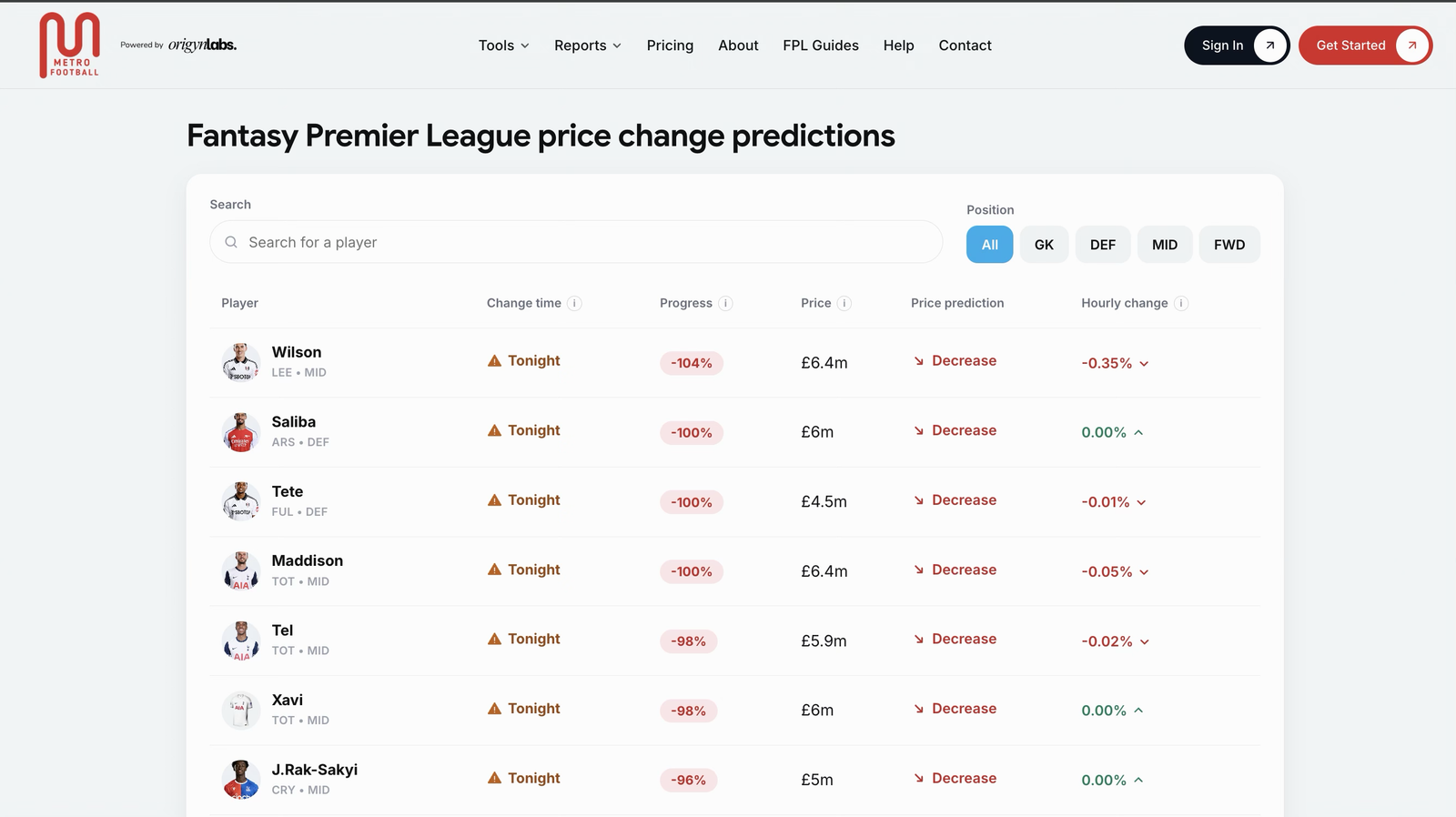
FPL player prices rise and fall based on transfer activity across the wider game.
When many managers transfer a player in, his price may rise. When many managers transfer a player out, his price may fall.
Each change happens in £0.1m steps.
So, a player priced at £6.0m may move to:
- £6.1m after a rise
- £5.9m after a fall
Price changes help keep the FPL market dynamic. Popular players become more expensive as demand grows. Players who lose their place, suffer an injury or fall out of favour may become cheaper.
The change reflects what FPL managers are doing. It does not guarantee that a player will score more or fewer points.
That distinction matters.
A player can rise in price because of hype and still blank in the next Gameweek. Another player can fall because of one poor result and then return to form.
How do the price change rules work?
The basic FPL price change rules are straightforward:
- Prices move in £0.1m steps.
- A player can rise when net transfers in reach the required level.
- A player can fall when net transfers out reach the required level.
- Changes are processed overnight.
- A player’s price can move more than once during a wider period if transfer activity continues.
Net transfers means transfers in minus transfers out.
For example:
- 100,000 managers transfer a player in.
- 20,000 managers transfer him out.
- The net figure is 80,000 transfers in.
FPL uses transfer volume compared with a player’s ownership to decide when a price change should happen. A highly owned player generally needs more net transfers to move than a player owned by fewer managers.
The exact thresholds are not officially published. They can also be affected by factors such as a player’s ownership, flags and the current state of the game.
So, it is better to think of the threshold as a moving estimate. It is not a fixed rule such as “every 100,000 transfers causes a rise”.
This is why different websites can show different predictions.
When do FPL price changes happen?
FPL price changes happen overnight, once per day, using UK time.
Rises are typically processed around midnight to 1am UK time. Fallers can also drop during the night. The exact processing time can vary, so do not treat one particular minute as guaranteed.
The important point is this:
A transfer made at 11:59pm may not protect you from a price change if the game has already processed its update.
Price changes can also be affected by Gameweek locks, maintenance and changes to the game rules. Check the current official FPL information from the Premier League if you are unsure about the rules for the current season.
Your transfer decisions should still follow the FPL Gameweek deadline. That is the final time for making changes that affect the upcoming Gameweek. Price changes do not give you permission to ignore the deadline.
What does a price rise mean for your team?
A player rising from £6.0m to £6.1m does not automatically give you £0.1m more to spend.
Your squad has three useful value figures:
- Current player price: the player’s market price now.
- Selling value: what you receive if you sell him.
- Team value: the total value of your squad, including your bank balance and the selling values of your players.
When you buy a player, you pay his current price.
When you sell a player who has risen, you keep only half of the profit, rounded down to the nearest £0.1m.
This protects the game from managers building huge budgets simply by buying every rising player. It also means that a visible price rise is not always the same as an increase in your available transfer budget.
How selling value works
Here is the rule in practice.
You buy a player for £8.0m.
His price rises to £8.4m.
His total rise is £0.4m. You keep half of that profit, which is £0.2m.
Your selling price is therefore £8.2m.
You do not receive the full £8.4m.
The calculation looks like this:
- Purchase price: £8.0m
- Current price: £8.4m
- Total rise: £0.4m
- Your share of the rise: £0.2m
- Selling price: £8.2m
The rounding rule matters too.
If a player rises by £0.1m, you usually gain no selling profit. You need a total rise of £0.2m before your selling value increases by £0.1m.
If you buy at £7.0m and the player rises to £7.3m, you keep £0.1m of profit. The extra £0.1m does not reach the next full £0.2m band.
If a player falls below the price you paid, you take the full loss when you sell. There is no equivalent half-loss protection.
You can use the official FPL rules and basics as a reference, but always check for updates because rules can change between seasons.
Team value versus selling value
Team value can be useful over a long season, but it is easy to misunderstand.
Suppose your players have a combined market price of £101.0m. That does not necessarily mean you could sell your squad for £101.0m.
Some players may have risen since you bought them. You only keep half of those profits when selling.
Your selling value may therefore be lower than your total market value.
This matters most when you want to make several FPL budget transfers. A small difference can decide whether you can move from one player to another without taking a hit.
It also matters later in the season. Managers who bought a strong, in-form player early may have more flexibility than managers who waited. They benefit from the player’s points and may also gain some selling value.
But price alone should not decide who to transfer in FPL.
The best transfer is usually the player who offers the strongest combination of:
- Expected points
- Minutes and starting security
- Fixtures
- Form and role
- Value for money
- Your wider squad structure
A £0.1m rise is helpful. It is rarely worth bringing in the wrong player.
How to protect your team value
You do not need to check price predictions every hour. A calm process works better.
1. Avoid selling good players only because of a predicted fall
If a player is injured or has lost his place, selling may be sensible.
If he is still a good option and you want to keep him, do not sell automatically just because he may fall by £0.1m. You may end up using another transfer to buy him back later.
2. Do not panic-buy players rising in price
A player who is rising tonight may already be widely owned. You are not guaranteed an advantage by buying him before the rise.
Check whether he fits your team. Look at his fixtures. Consider whether he is the right answer for the next few Gameweeks.
3. Keep a small cash buffer
Using every last £0.1m can make your squad difficult to manage.
A small bank balance may help you respond to injuries, suspensions and unexpected team news. You do not need to spend your entire budget immediately.
4. Avoid taking hits for price reasons
A -4 hit costs points. A £0.1m price rise may never repay that cost.
Only consider an early move when the football reason is strong too, such as a clear fixture swing, a serious injury or a player becoming an important long-term pick.
How to use FPL price change predictions
Price predictions are useful information. They are not certainty.
You can use our FPL price change predictions page to see which players may rise or fall and how close they appear to a possible change.
Use that information to support your planning:
- Check whether a player you already own may fall.
- Check whether a transfer target may rise before you can buy him.
- Compare the likely price change with your transfer timing.
- Decide whether waiting gives you useful information.
- Keep the player’s points potential as the main factor.
A prediction can change before the overnight update. Net transfers can slow down. More managers can make a move. The game can also apply rules that are not fully visible to the public.
Nobody can predict FPL price changes with certainty.
Common mistakes to avoid
“Price changes happen instantly”
They do not. They are processed during scheduled overnight updates.
“Every £0.1m rise increases my selling value”
It does not. You normally need a £0.2m total rise to gain £0.1m in selling value.
“I should always buy before a rise”
Not if the player is a poor fit for your team. A bad transfer made early is still a bad transfer.
“Chasing price rises wins mini leagues”
Points win mini leagues. Team value can give you more options, but it does not replace good captaincy, transfers or squad planning.
“The predicted players will definitely rise tonight”
Predictions are estimates. They can be wrong.
A calmer way to manage price changes
Use price changes as part of your planning, not as a reason to panic.
Before making a late-night transfer, ask:
- Would I still want this player if his price did not change?
- Is the transfer good for my next few Gameweeks?
- Am I protecting a sensible amount of team value?
- Could I wait for more information?
- Is the move worth using my free transfer or taking a hit?
- Will I still have enough budget for future changes?
If the football decision is sound, a price change may help you act at the right time.
If the only reason for the move is fear of missing £0.1m, waiting is often the better choice.
The main lesson
FPL price changes are worth understanding, but they should not control your season.
Prices rise and fall because of net transfer activity. Changes usually happen overnight in £0.1m steps. You keep only half of any profit when selling a player who has risen, rounded down.
Use price change predictions as a guide. Keep some money in the bank when it suits your squad. Avoid panic transfers. Most importantly, choose players for their expected points and role, not just because they are among the players rising in price in FPL.
Check the market when you need to. Then make the decision that gives your team the best chance of scoring well at the next FPL Gameweek deadline.