
It is Sunday night.
The final match has finished, but your FPL week is already starting again.
You are looking at your team on one screen, your mini league on another and several browser tabs in between. One rival has climbed above you. Another has already made a transfer. Someone in the group chat is talking about a player you have barely considered.
The next Gameweek deadline is approaching.
You start asking familiar questions:
- Should you make a transfer now?
- Is your captain still the right pick?
- Has a player’s price changed?
- Is that new injury concern serious?
- Is everyone else buying the same player?
- What is the best FPL team this Gameweek?
This is how a simple fantasy football game can start to feel like a second job.
The good news is that you do not need to follow every opinion or spend hours studying every statistic. You need a repeatable routine that helps you make the important decisions in the right order.
Here is the routine we recommend at Metro Football.
The 10 minutes that save your Gameweek
A strong FPL routine has five simple stages:
- Review what happened.
- Check the fixtures.
- Watch for team news.
- Plan your transfers and captain.
- Complete your final checks before the deadline.
You can do this in short sessions across the week. You do not need to solve your entire season on one evening.
Our FPL Gameweek Tips page can help you bring these decisions together. It shows the main picks, risks and opportunities for the current Gameweek.
1. After the final whistle: review before reacting
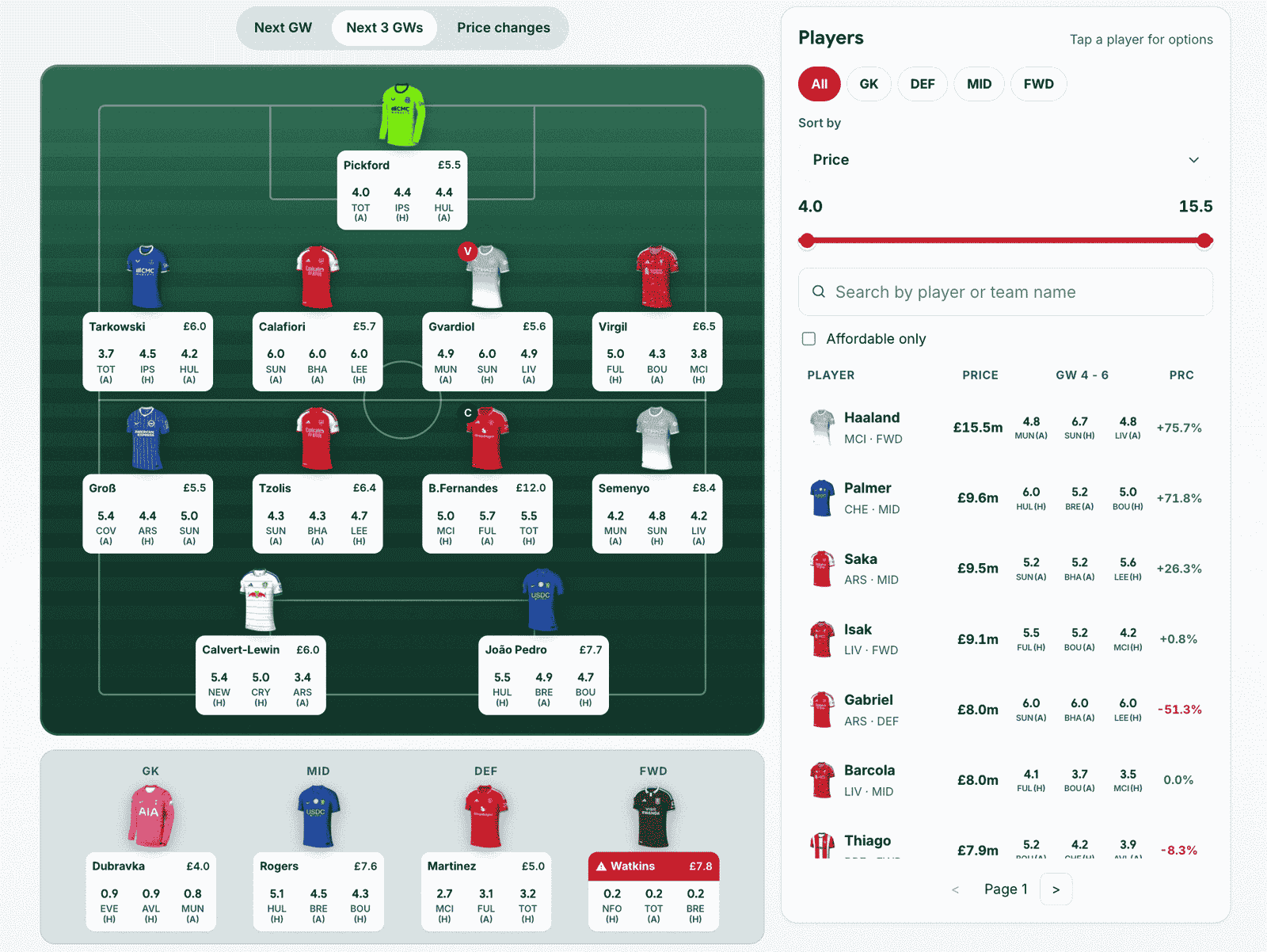
Try a different approach.
Use the Gameweek Recap to see what actually happened. Check the top scorers, popular players who blanked, successful captains and low-owned players who made a difference.
Then ask three questions:
- Did my captain have a reasonable fixture and role?
- Did my players receive the minutes I expected?
- Was my transfer based on useful information or recent points?
A player scoring twice does not always mean you missed an obvious transfer. A defender blanking does not always mean the decision was wrong.
Good FPL management is about making sound decisions with the information available. One result can go against you.
The recap helps you learn without overreacting. It also gives you a clearer starting point for the next Gameweek.
2. Early in the week: check the fixture picture
Once you have reviewed the previous Gameweek, look ahead.
Do not only check the next match. Look at the next three to six fixtures. This helps you avoid buying a player for one attractive fixture, only to face a difficult run immediately afterwards.
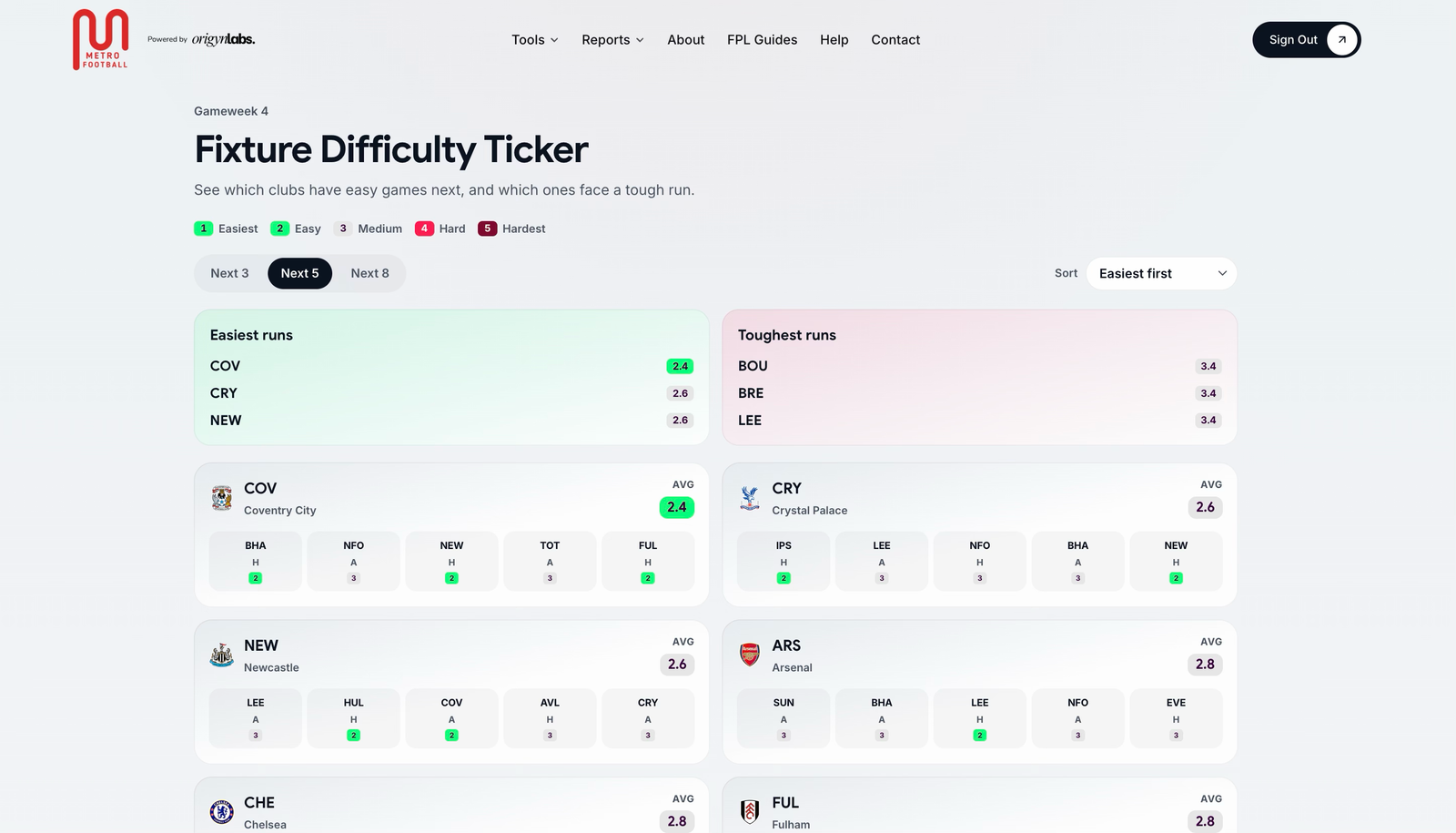
The Fixture Difficulty Ticker colour-codes upcoming fixtures. You can quickly see which clubs have a favourable run and which teams may face several difficult matches.
Use it to review:
- Your current defenders.
- Your main captain options.
- Players you may want to buy.
- Teams you may want to move away from.
- Potential Wildcard or chip periods.
This is also a good time to review your squad structure. Do you have enough reliable starters? Is your bench capable of covering a rotation risk? Do you have at least one captain option with a strong fixture?
Fixture planning does not guarantee points. Football remains unpredictable. It simply helps you avoid making decisions based on one isolated match.
3. Midweek: check form, minutes and team news
The middle of the week is your information window.
This is when you can look at player performance without rushing to confirm a transfer. Useful information includes:
- Recent minutes.
- Starting positions.
- Set-piece involvement.
- Goals and assists.
- Chances created.
- Defensive actions.
- Injury and suspension updates.
- Expected rotation.
Player points are useful, but they are only part of the picture. Use FPL player stats to understand how a player is contributing. A midfielder may have blanked while still creating good chances. A forward may have scored from one unlikely opportunity.
An FPL form guide can help you spot players who are consistently involved. You can also compare FPL expected goals data, often shown as xG, with actual goals. Expected goals estimates the quality of a player’s scoring chances. It does not predict the future, but it can show whether a player is regularly getting into promising positions.
The important question is simple:
> Is this player likely to keep getting minutes and opportunities?
That question is often more useful than chasing the highest score from the previous Gameweek.
Keep an eye on the Injury Risk Digest as the week develops. A player who looked like an easy transfer on Monday may become a poor choice after an injury update or a change in expected minutes.
4. The day before the deadline: plan transfers and captaincy
Start with your current squad. Do not begin with the player who is trending online. Check whether your team has a real problem.
Prioritise:
- A player who may not play.
- A player with a long-term injury or suspension.
- A player losing minutes.
- A weak fixture run.
- A missing captain option.
- A luxury transfer that improves an already healthy squad.
The Transfer Planner helps you compare possible moves before you confirm them. You can consider the player leaving, the player joining and how the change affects your team over several Gameweeks.
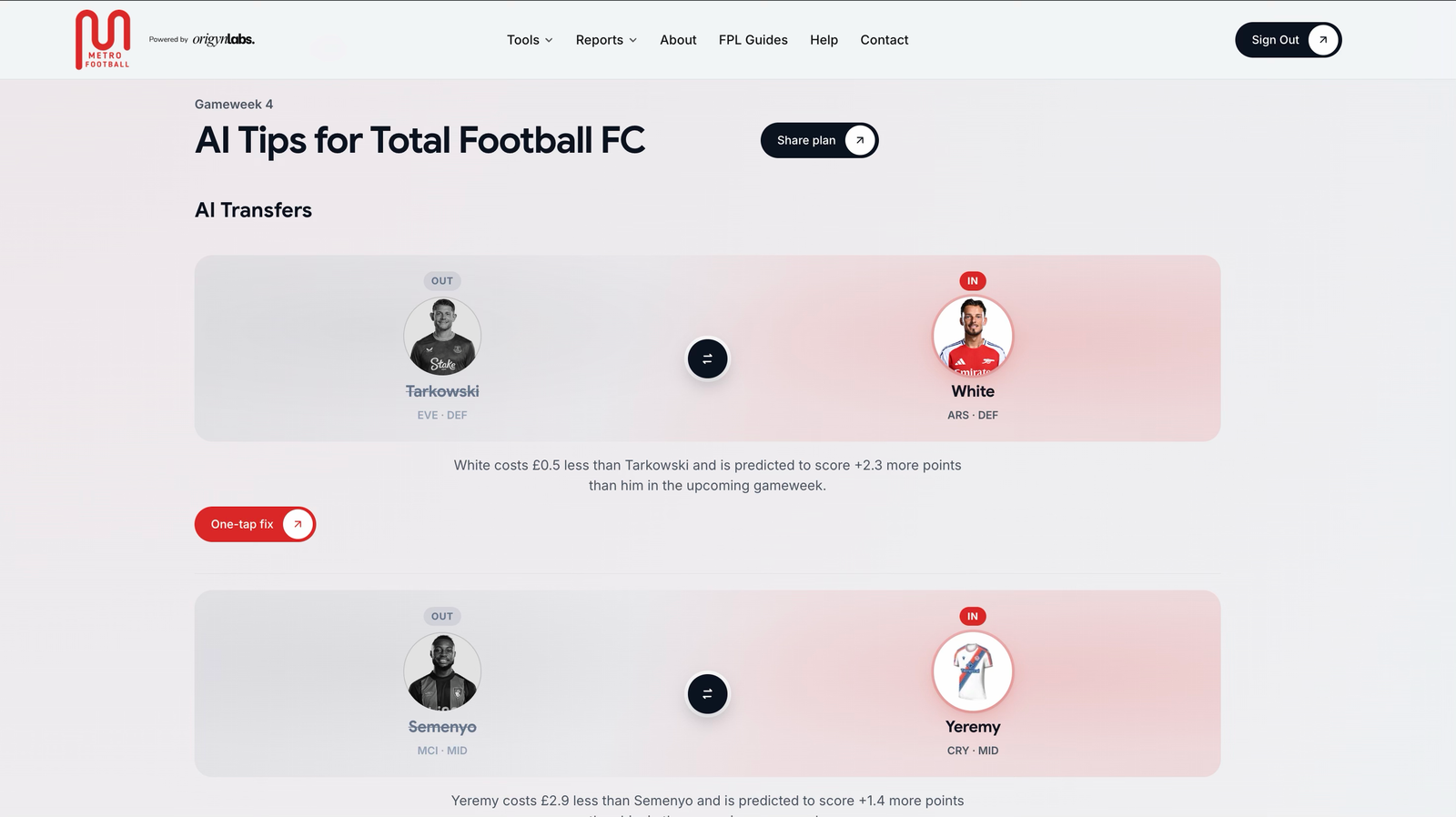
Premium users can also use AI Transfers. This FPL AI tool reviews your squad, fixtures, form, price movements and available options before suggesting a transfer for your specific team.
That is different from copying a general list of popular players. A useful FPL AI assistant should consider your budget, existing squad and mini league situation.
We still recommend checking the reasoning. AI can support your decision, but it cannot remove uncertainty from football.
Choose your captain with a simple checklist
Captaincy can change your Gameweek quickly, so keep the process clear.
Look for a player who:
- Is likely to start.
- Has a favourable fixture.
- Takes penalties or set pieces.
- Plays a central role in the attack.
- Has shown reliable involvement.
- Has a safe vice-captain available.
The Rate My Team tool evaluates your squad and ranks captain options for the next Gameweek. It gives you an answer first, then helps you understand the main strengths and weaknesses in your team.
Do not change your captain simply because another option scored well last week. Change your choice when the fixture, minutes or role gives you a clear reason.
5. Deadline day: complete the final checks
The FPL Gameweek deadline is not the time for five new ideas.
It is the time to confirm your plan.
Before the deadline, check:
- The latest injury news.
- Press conference updates.
- Suspensions.
- Rotation risks.
- Your starting XI.
- Your captain and vice-captain.
- Your bench order.
- Your available transfers.
- Any price changes that affect your budget.
The Price Change Predictions page can show which players may rise or fall. These are predictions, not guarantees. Do not make a poor football decision just to protect a small amount of team value.
If there is no clear transfer, rolling the move can be the sensible choice. Two free transfers can give you more flexibility when an injury, fixture swing or blank Gameweek appears.
Use chips and differentials with a reason
Chips work best when they fit into your wider plan.
The Chip Strategy Planner helps you assess potential periods for your Wildcard, Free Hit, Bench Boost and Triple Captain. You do not need to use a chip because other managers are discussing it. Use one when the fixtures and your squad create a clear opportunity.
The same applies to differentials.
A differential is a low-owned player who could help you gain ground in your mini league. The Differential Finder helps you identify players with useful form, fixtures or underlying numbers.
A differential should still have a reason behind it. Low ownership on its own is not enough.
Keep your mini league in view
FPL is more enjoyable when you know what you are playing for.
The Mini League Tracker shows your ranking and movement against your rivals. It can help you see whether you need to protect a lead, close a gap or make a measured attempt to gain ground.
You do not need to copy every move your rivals make. Instead, ask:
- Which players do we both own?
- Where can I gain a small advantage?
- Is my rival’s captain choice a risk worth responding to?
- Do I need a differential, or should I protect my position?
This gives your decisions context without turning every Gameweek into a panic.
What is the best FPL app or website for this routine?
The best FPL app in 2026 is not necessarily the one with the most opinions. The best FPL website is the one that helps you move from information to a clear decision.
You may use one site for news, another FPL stats site for numbers and a third source for team news. That can work, but too many tabs often create more doubt.
Metro Football brings the main decisions into one simple workflow:
- Review the previous Gameweek.
- Check fixture runs.
- Compare player information.
- Plan transfers.
- Pick a captain.
- Track your mini league.
- Review chip opportunities.
You can start with our free plan. It includes reports and core tools, including the Fixture Difficulty Ticker, Gameweek Recap, Price Change Predictions, Differential Finder, Rate My Team and tracking for one mini league.
When you are ready, Premium adds AI Transfers, deeper squad planning, predicted points, chip planning, unlimited mini leagues and rival alerts. It costs £4 per month, with a yearly option available.
If you do not win your mini league by the end of the season, our FPL money back guarantee means we refund your Premium payments for that season, subject to the plan terms.
Start free with Metro Football.
A calmer Gameweek starts with one repeatable process
You will still have lucky goals, unexpected benchings and captains who miss chances.
No FPL routine can remove that.
What a routine can do is reduce the rushed decisions around those moments. Review the last Gameweek. Check the fixtures. Watch the team news. Plan your transfer and captain. Complete your final checks.
Then stop tinkering.
Good FPL management is not about knowing everything. It is about asking the right questions at the right time, with less noise around you.
Start with ten focused minutes this Gameweek and build from there.