

A single season of goals can define a player’s entire legacy. One year can turn a brilliant striker into a name people use as a reference point decades later. Think of it as a player leaving one enormous footprint in wet cement.
The Premier League began in 1992 and has now completed 34 seasons. The first three campaigns ran for 42 matches, while every season from 1995/96 onwards used the familiar 38-game format. That difference matters. It is the reason the debate around the greatest scoring season never quite disappears.
Erling Haaland holds the record with 36 goals for Manchester City in 2022/23. Andy Cole and Alan Shearer reached 34, Mohamed Salah scored 32, and Shearer, Luis Suárez and Cristiano Ronaldo each reached 31. The numbers are impressive on their own, but the season length and scoring context help us understand just how impressive they really were.
This article covers the record, the near-misses and the players who came closest. It also looks at penalties, hat-tricks, the 42-game versus 38-game argument and the question supporters keep asking: can anyone break 36?
The Record at a Glance
| Rank | Player | Club | Season | Goals |
|---|---|---|---|---|
| 1 | Erling Haaland | Manchester City | 2022/23 | 36 |
| 2 | Andy Cole | Newcastle United | 1993/94 | 34 |
| 2 | Alan Shearer | Blackburn Rovers | 1994/95 | 34 |
| 4 | Mohamed Salah | Liverpool | 2017/18 | 32 |
| 5 | Alan Shearer | Blackburn Rovers | 1993/94 | 31 |
| 5 | Alan Shearer | Blackburn Rovers | 1995/96 | 31 |
| 5 | Luis Suárez | Liverpool | 2013/14 | 31 |
| 5 | Cristiano Ronaldo | Manchester United | 2007/08 | 31 |
| 9 | Harry Kane | Tottenham Hotspur | 2017/18 | 30 |
| 9 | Harry Kane | Tottenham Hotspur | 2022/23 | 30 |
| 9 | Thierry Henry | Arsenal | 2003/04 | 30 |
| 9 | Robin van Persie | Arsenal | 2011/12 | 30 |
| 9 | Kevin Phillips | Sunderland | 1999/2000 | 30 |
| 14 | Harry Kane | Tottenham Hotspur | 2016/17 | 29 |
| 14 | Didier Drogba | Chelsea | 2009/10 | 29 |
| 14 | Mohamed Salah | Liverpool | 2024/25 | 29 |
| 17 | Robbie Fowler | Liverpool | 1995/96 | 28 |
| 18 | Thierry Henry | Arsenal | 2005/06 | 27 |
| 18 | Erling Haaland | Manchester City | 2023/24 | 27 |
| 18 | Erling Haaland | Manchester City | 2025/26 | 27 |
How to read the table
The table ranks individual Premier League seasons, not a player’s career total. That distinction is important. Alan Shearer appears more than once because several of his campaigns belong among the best ever.
The figures are based on league goals only. FA Cup, Champions League and international goals do not count. The Premier League’s official records provide the main statistical reference point, while season-by-season data can also be checked against Wikipedia’s top scorers by season.
Why the season length changes everything
Cole and Shearer played in 42-game seasons. That gave them four more league matches than Haaland, Salah, Suárez and Ronaldo had in their record-chasing campaigns.
That does not make the early records less valuable. It does mean we should compare rates as well as totals. A player scoring 34 in 42 games averages fewer goals per match than a player scoring 36 in 38. Raw totals tell one part of the story; context completes it.
The Top 20 Highest-Scoring Premier League Seasons
The shape of the list
The list is dominated by centre-forwards and wide forwards who played in attacking teams. Manchester City, Liverpool, Arsenal, Manchester United, Tottenham Hotspur and Blackburn Rovers all appear because sustained team pressure creates more chances.
There is also a clear modern pattern. The top end was once built around 30 goals being a remarkable exception. Now, several elite forwards have made 25 to 30 goals feel more attainable. Even so, reaching 30 remains rare.
The 40-game problem
The early Premier League had 22 clubs, which meant each club played 42 league matches. From 1995/96, the league moved to 20 clubs and 38 matches.
Should Cole’s 34 be adjusted down to a 38-game equivalent? You can make that calculation, but it remains an estimate rather than an official record. Injuries, fixture order, form and opposition all change from season to season. A straight-line adjustment can be useful for discussion, but it cannot recreate the matches that never happened.
1. Erling Haaland, 36 Goals in 2022/23
The season that broke a 28-year record
Haaland’s 36 goals for Manchester City broke a record that had stood since Andy Cole’s 34 in 1993/94. He passed Cole and Shearer with a season that felt relentless from the opening months.
The timing made it even more significant. Haaland did not break the record in a weaker competition or a shortened campaign. He scored 36 in a 38-game Premier League season, and Manchester City won the title too. BBC Sport covered the achievement as one of the defining scoring records of the modern era.
How he did it
Haaland combined volume, movement and ruthless finishing. He attacked crosses, ran behind defensive lines and arrived in the penalty area before defenders could reset. Manchester City also created a steady supply of chances through possession and passing.
His record was not built on one spectacular month. It came from repeated contributions across the campaign. That consistency is the real lesson. A hat-trick can change a weekend, but 36 goals require a forward to stay dangerous for almost an entire season.
2. Andy Cole, 34 Goals, and Alan Shearer, 34
Cole’s 34, and the one-penalty detail
Andy Cole scored 34 for Newcastle United in 1993/94. It remains the joint-highest total outside Haaland’s record and the best mark in a 42-game Premier League season.
One detail makes Cole’s tally especially interesting: only one of his 34 goals came from a penalty. That means his record relied overwhelmingly on open-play finishing and chances created during Newcastle’s attacking football.
Shearer’s 34 and the title that came with it
Alan Shearer matched Cole’s total for Blackburn Rovers in 1994/95. He did so in the final 42-game season and helped Blackburn win the Premier League title.
Shearer’s campaign sits naturally alongside Alan Shearer’s place among the greatest Premier League attackers. He was powerful, direct and exceptionally reliable in the penalty area. Cole’s season was the first mountain; Shearer climbed it immediately afterwards.
3. Mohamed Salah, 32 Goals in 2017/18
The best 38-game season by a winger
Mohamed Salah scored 32 league goals for Liverpool in 2017/18. Before Haaland surpassed it, that was the record for a 38-game Premier League season.
Salah reached the total from a wide attacking position rather than as a traditional central striker. He repeatedly moved inside from the right, attacked space behind full-backs and finished with his left foot before defenders could close him down.
His season remains one of the standout campaigns among Liverpool’s greatest scorers and players. Liverpool created a fast, open attacking environment, but Salah still had to convert the opportunities.
Why 32 deserves the asterisk removed
People sometimes describe Salah’s total as less impressive because Haaland later scored 36. That misses the point. Records change, but the previous record does not become ordinary.
Salah’s 32 was achieved in the modern 38-game format and from a role that demanded more than penalty-box finishing. He created danger from wide areas, carried the ball and still produced the kind of goal total usually associated with an out-and-out number nine.
The 31-Goal Seasons
Shearer, 31 in 1993/94
Shearer scored 31 league goals for Blackburn Rovers in 1993/94 and won the Golden Boot that season. He still finished three behind Andy Cole’s 34 for Newcastle United, which shows how unusually high the top of the scoring chart was in that 42-game campaign.
It also mattered as a sign of what was coming next. That 31-goal season set up Shearer’s record-matching 34-goal campaign in 1994/95, when he helped Blackburn win the title and moved from elite scorer to one of the defining forwards of the Premier League era.
Shearer, 31 in 1995/96
Shearer scored 31 for Blackburn Rovers in 1995/96, the first 38-game season after the league changed format. He made 35 appearances and still finished above almost every major scoring season that followed.
That campaign also shows why appearances matter. A total of 31 in 35 matches is an extraordinary return, even before we consider the defensive football of the era.
Suárez, 31 in 2013/14
Luis Suárez scored 31 for Liverpool in 2013/14. His season mixed close control, aggressive pressing, long-range shooting and movement that constantly unsettled defenders.
Liverpool came close to winning the title that year, and Suárez’s goals drove the challenge. He often looked less like a fixed striker and more like a player carrying an entire attack in different directions.
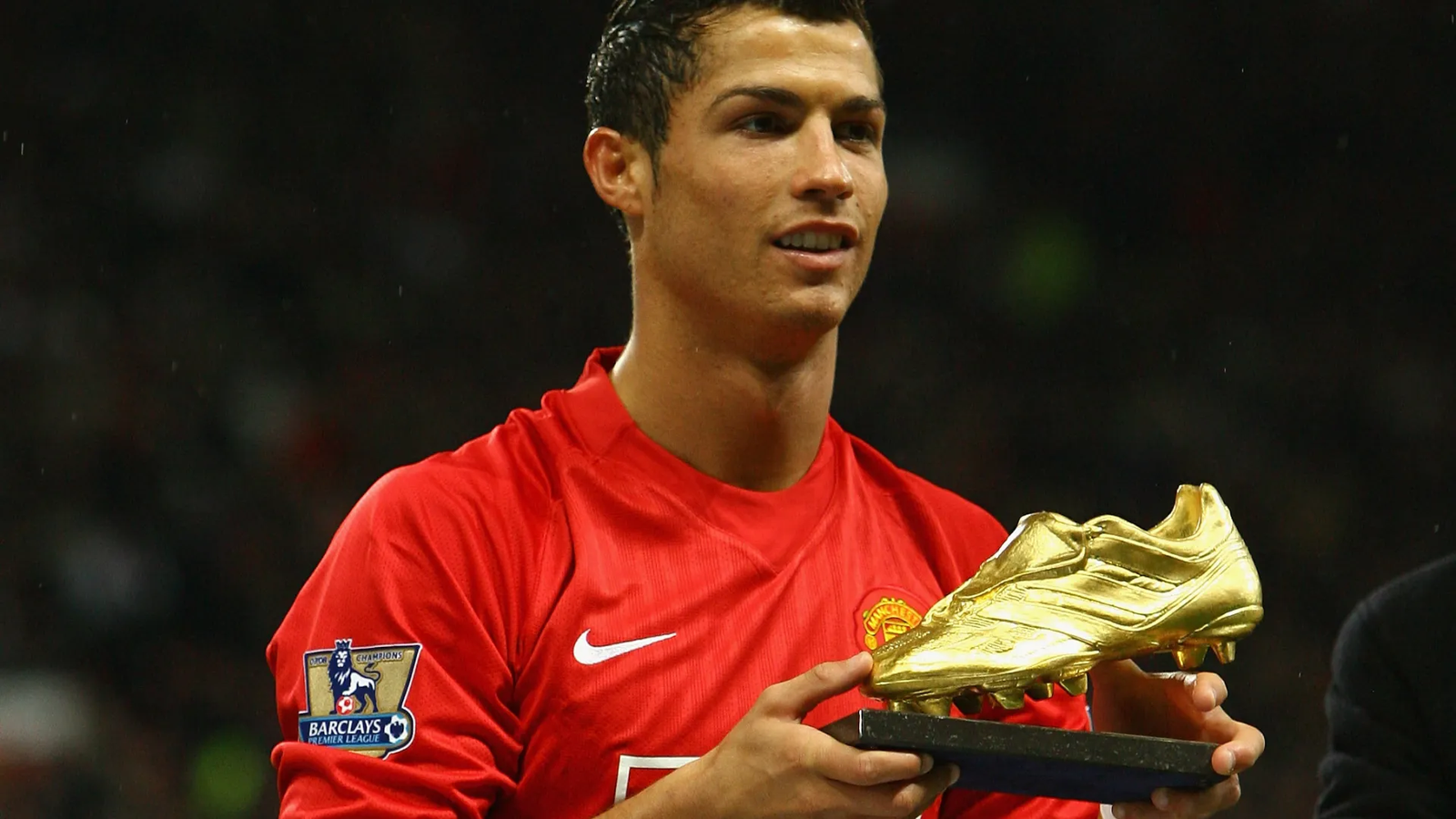
Ronaldo, 31 in 2007/08
Cristiano Ronaldo scored 31 for Manchester United in 2007/08. It was the campaign that established him as a complete Premier League forward rather than simply a gifted winger.
His goals came from headers, free-kicks, counter-attacks and powerful runs into the box. The season remains central to discussions about the best Manchester United players in history.
The 30-Goal Seasons
Kevin Phillips, 30 in 1999/2000
Kevin Phillips scored 30 for Sunderland in 1999/2000. He won the Golden Boot and became the first Englishman to win the European Golden Shoe.
His season stands out because Sunderland were not one of the established superpowers. Phillips combined sharp movement with quick finishing and made every half-chance feel dangerous.
Thierry Henry, 30 in 2003/04
Thierry Henry scored 30 for Arsenal in the unbeaten 2003/04 campaign. He was not simply finishing moves; he was often starting them too.
Henry drifted into wide areas, carried the ball through midfield and then arrived in the box. His season belongs in any conversation about the best Arsenal players of all time.
Robin van Persie, 30 in 2011/12
Robin van Persie scored 30 for Arsenal in 2011/12. He was one of the most technically complete finishers on the list, capable of scoring with his left foot, right foot and head.
His movement around the penalty area was subtle. He did not always need a clear run. A small change of direction was often enough to create the shooting angle.
Harry Kane, 30 in 2017/18
Harry Kane scored 30 for Tottenham Hotspur in 2017/18, finishing behind Salah in the Golden Boot race. Kane also reached 30 in 2022/23 and scored 29 in 2016/17.
His importance came from his range. Kane could finish crosses, shoot from distance, drop into midfield and play passes that opened the next attack. That combination made him harder to mark than a striker who stayed in one zone.
Table 2: Every Premier League Season With 30 or More Goals
| Player | Club | Season | Goals | Games played | Penalty goals or notes |
|---|---|---|---|---|---|
| Erling Haaland | Manchester City | 2022/23 | 36 | 37 | Manchester City won the title |
| Andy Cole | Newcastle United | 1993/94 | 34 | 40 | One penalty; 42-game season |
| Alan Shearer | Blackburn Rovers | 1994/95 | 34 | 42 | 42-game season; Blackburn won the title |
| Mohamed Salah | Liverpool | 2017/18 | 32 | 36 | Record for a 38-game season before Haaland |
| Robin van Persie | Arsenal | 2011/12 | 30 | 38 | Golden Boot winner |
| Harry Kane | Tottenham Hotspur | 2017/18 | 30 | 37 | Golden Boot winner |
| Harry Kane | Tottenham Hotspur | 2022/23 | 30 | 38 | Golden Boot winner |
| Alan Shearer | Blackburn Rovers | 1993/94 | 31 | 40 | Golden Boot winner |
| Alan Shearer | Blackburn Rovers | 1995/96 | 31 | 35 | Golden Boot winner |
| Luis Suárez | Liverpool | 2013/14 | 31 | 33 | Golden Boot winner |
| Cristiano Ronaldo | Manchester United | 2007/08 | 31 | 34 | Golden Boot winner |
| Kevin Phillips | Sunderland | 1999/2000 | 30 | 37 | Golden Boot winner |
| Thierry Henry | Arsenal | 2003/04 | 30 | 37 | Golden Boot winner |
| Robin van Persie | Arsenal | 2011/12 | 30 | 38 | Golden Boot winner |
| Harry Kane | Tottenham Hotspur | 2017/18 | 30 | 37 | Golden Boot winner |
| Harry Kane | Tottenham Hotspur | 2022/23 | 30 | 38 | Golden Boot winner |
What the second table shows
Only a small group of player-seasons have reached 30 goals. That tells us how demanding the target is. A striker can be excellent for several years and never reach it once.
The table also shows that 30-goal seasons come in different shapes. Phillips carried Sunderland’s attack, Henry powered an unbeaten Arsenal side, Salah scored from the wing and Haaland led a title-winning Manchester City team.
Penalties, and how much they inflate a total
Penalties are part of football, so there is no reason to remove them from official totals. They are still useful to separate when comparing players.
Cole’s one penalty is confirmed. For the other entries, this draft uses dashes rather than guessing. That is the honest approach. A complete penalty breakdown would need a consistent event database for every campaign. For modern FPL-related context, our article on Premier League penalty takers explains why spot-kicks can affect player value and scoring expectations.
Why Midfielders Almost Never Get Near 30
The role of position
Midfielders usually begin attacks farther from goal. They may create chances, carry the ball or control the tempo, but they do not receive every opportunity inside the six-yard box.
That changes the maths. A forward might have several chances in one match. A midfielder can dominate a game and still finish with one shot. This is why the greatest Premier League midfielders are often judged through a broader mix of goals, assists, passing and influence.
The modern forward’s advantage
Today’s elite forwards also benefit from highly structured attacking systems. Full-backs push forward, wingers move inside and midfielders make late runs. The striker often receives the final pass after several players have already moved the defence.
That does not make goals easy. It makes the forward’s role more specialised. When the system works, the best finisher can produce a huge total.
Penalties, Expected Goals and the Honest Picture
How many goals come from the spot
A penalty is a chance with different conditions from open play. The player has time, the ball is still and only the goalkeeper stands between the taker and the net.
That does not mean penalties are automatic. Pressure, technique and goalkeeper research all matter. It does mean a total with many penalties has a different scoring profile from one built almost entirely from open play.
What xG tells us about these seasons
Expected goals, or xG, estimates how likely a chance is to become a goal. It does not tell us exactly what will happen. It helps us understand the quality and volume of chances instead.
If you want a simple explanation of expected goals (xG) and other football statistics, think of xG as a chance-quality thermometer. It does not decide the match, but it shows whether a player regularly reaches dangerous positions.
The Single-Match Records
The highest-scoring game
The highest-scoring Premier League match remains Portsmouth’s 7-4 win over Reading on 29 September 2007. Eleven goals in one match is a reminder that season records are built from many different types of game.
A player can score four in a chaotic match, but maintaining a high total requires goals against defensive, organised and physical opponents too.
Hat-trick records that stand alongside the season totals
Sergio Agüero holds the Premier League record for most hat-tricks, with 12. Alan Shearer holds the single-season record with five hat-tricks in 1995/96. Sadio Mané scored the fastest hat-trick, completing one in two minutes and 56 seconds.
Haaland has never scored five goals in one Premier League match. His five-goal game came for Manchester City against RB Leipzig in the Champions League during 2022/23. That distinction matters when headlines blur domestic and European records.
The 42-Game Versus 38-Game Argument
The case for Cole and Shearer
Cole and Shearer had 42 matches available, but scoring 34 still demanded elite consistency. More fixtures also create more opportunities for injuries, suspensions, poor form and tactical changes.
The strongest case for the early records is simple: both players dominated their campaigns. They did not merely benefit from four extra games. They turned the additional schedule into a historic total.
The case for Haaland and Salah
Haaland’s 36 and Salah’s 32 came in 38-game seasons. Their totals arrived in a more compact format, which strengthens the rate-based argument.
Haaland’s 36 in 38 matches is the official record, and that is the cleanest answer to the question. Still, if you are asking which season was most difficult relative to its era, the debate remains open.

Could Anyone Break 36?
Haaland’s position
Haaland is the obvious candidate because he has already done it once. He scored 27 in 2023/24 and 22 in 2024/25, while reaching at least 20 goals in each of his first four Premier League seasons.
As of 5 September 2026, he had 115 Premier League goals in 135 appearances. That record suggests he can produce another exceptional campaign, although no striker can avoid injuries, rotation or changes in team form forever.
The wider field
The next challenger may not be the obvious one. Salah scored 29 goals and provided 18 assists in 2024/25, producing 47 goal involvements. That matched the single-season record set by Cole and Shearer.
Salah also became the first player to win the Golden Boot, Playmaker award and Player of the Season award in one campaign. His fifth 20-goal season shows that sustained excellence can matter just as much as one record-breaking year.
How the 2026/27 Season Fits In
What to watch this season
The 2026/27 season is still developing, so it would be careless to project a final scoring race from a small sample. The sensible questions are different: who is receiving regular minutes, who is taking penalties and which clubs are creating the most high-quality chances?
Brian Brobbey scored a hat-trick in Sunderland’s 5-3 defeat to Manchester City on 20 September 2026. That made him only the sixth player in Premier League history to score a hat-trick in a losing cause. It is a memorable match record, but it is not evidence that he is on course for 30 goals.
The record’s shelf life
Haaland’s 36 may stand for years because the conditions have to align. A forward needs fitness, a strong team, regular starts, penalty responsibility and a remarkable level of finishing.
Records often look breakable until you examine everything that went into them. Then they look more like mountains than milestones.
Final Thoughts
The answer in one line
Erling Haaland holds the record for most goals in a Premier League season with 36 for Manchester City in 2022/23.
The caveat worth keeping
Cole and Shearer scored 34 in 42-game seasons, while Salah’s 32 was the best 38-game total before Haaland. The numbers belong to different eras, so the fairest comparison includes both the raw total and the conditions around it.
The record is Haaland’s, but the argument about the greatest scoring season remains a matter of judgement rather than a calculation with one perfect answer.
Sources and Methodology
How the evidence was prioritised
Official competition records were prioritised first because the Premier League is the primary authority for goals, seasons and player records. Historical totals were then cross-checked against Opta Analyst, BBC Sport, ESPN, Sky Sports, Transfermarkt and StatMuse.
How the tables were built
Table 1 ranks the highest individual season totals identified in the available season-by-season records. Table 2 includes every listed player-season with at least 30 goals. Games played and penalty details appear only where they were verified for this draft. Dashes mean the figure was not confirmed, not that the player recorded zero.
Additional record checks included Guinness World Records, Wikipedia’s season-by-season scorer list and Football365.
Limits of the comparison
The 42-game versus 38-game comparison cannot produce one indisputable adjusted ranking. A mathematical adjustment would estimate matches that were never played. The question of the “greatest” season also includes editorial judgement. This article separates official totals from interpretation and avoids presenting opinion as a measurable fact.
Last checked: 21 September 2026. Season totals are updated after each completed campaign.
If you spot an error or have a correction, please contact us through the Metro Football contact page.
FAQs
Who has scored the most goals in a Premier League season?
Erling Haaland holds the record. He scored 36 goals for Manchester City in the 2022/23 Premier League season.
How many goals did Haaland score in 2022/23?
Haaland scored 36 Premier League goals in 2022/23. Manchester City also won the title that season.
Did Andy Cole and Alan Shearer both score 34 goals?
Yes. Andy Cole scored 34 for Newcastle United in 1993/94, while Alan Shearer scored 34 for Blackburn Rovers in 1994/95. Both totals came in 42-game seasons.
What is the record in a 38-game Premier League season?
The official overall record is now Haaland’s 36 goals in 2022/23. Before that, Mohamed Salah held the 38-game record with 32 goals for Liverpool in 2017/18.
Has anyone scored 40 goals in a Premier League season?
No player has scored 40 Premier League goals in a single season. Haaland’s 36 is the current record.
Who has scored the most Premier League hat-tricks?
Sergio Agüero holds the record with 12 Premier League hat-tricks. Alan Shearer scored five in the 1995/96 season, which remains the single-season record.
What is the most goals scored in one Premier League match?
The highest-scoring match remains Portsmouth’s 7-4 win over Reading on 29 September 2007. The game produced 11 goals.
Can Haaland break his own record?
He can, but it would require an exceptional combination of fitness, minutes, chances, penalty responsibility and finishing. His previous record makes him the obvious candidate, but it does not make another 36-goal season inevitable.
How many goals did Salah score in 2024/25?
Mohamed Salah scored 29 Premier League goals in 2024/25 and added 18 assists. His 47 goal involvements equalled the single-season record set by Andy Cole and Alan Shearer.
Why are 42-game and 38-game seasons compared differently?
A 42-game season gave players four more league matches to score. A 38-game season offers fewer opportunities, so raw totals should be read alongside goals per match, appearances and the wider competitive context.