
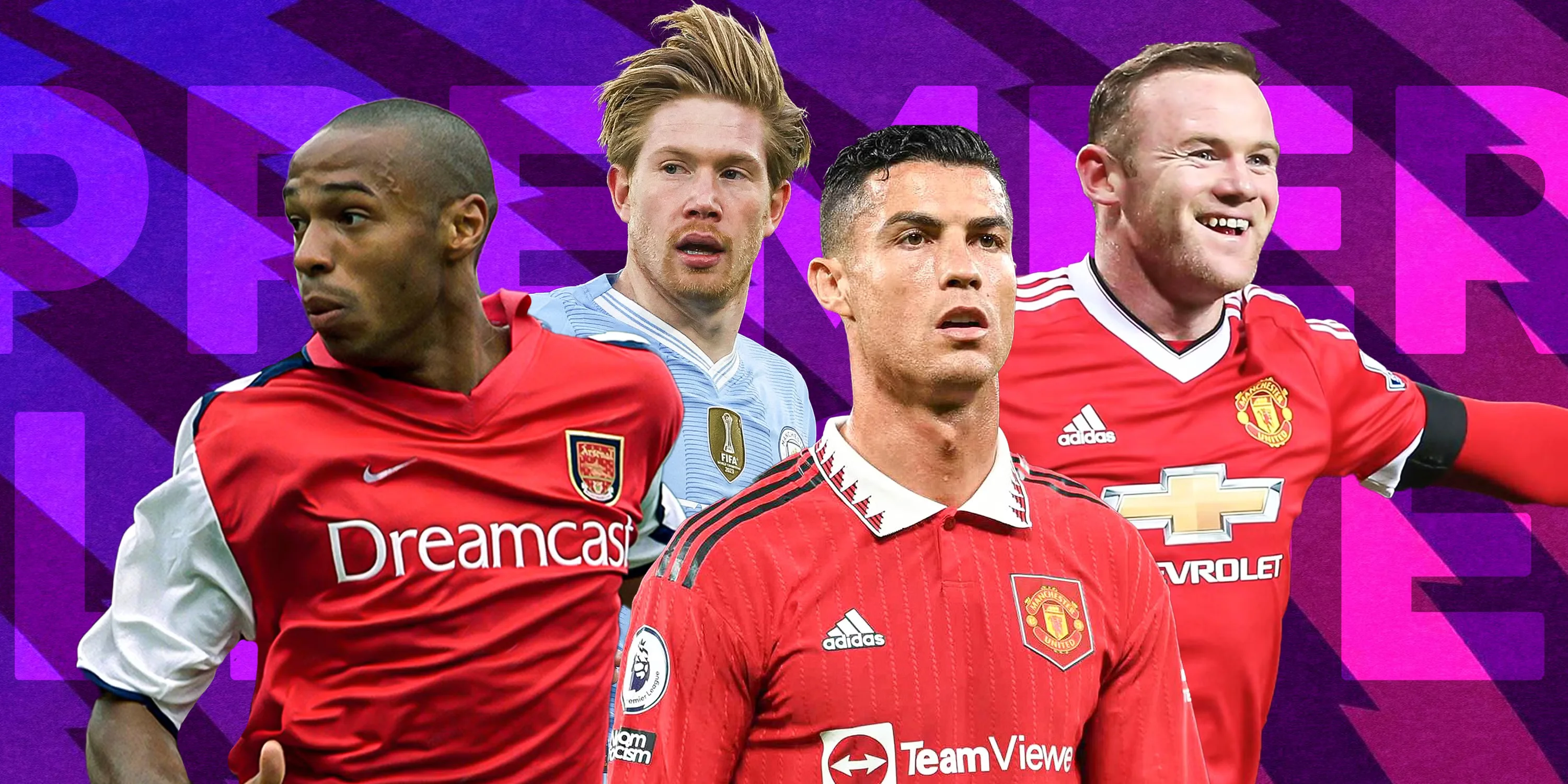
The Premier League began in 1992. Now, with its 35th campaign under way, the competition has created 34 completed seasons of arguments in pubs, living rooms and football group chats. Seven clubs have won the title. Manchester United lead with 13 championships, followed by Manchester City with eight and Chelsea with five. Arsenal won their fourth Premier League title in 2025/26, ending a 22-year wait since 2003/04.
And the players? Thierry Henry, Alan Shearer, Ryan Giggs, Mohamed Salah and Cristiano Ronaldo all have strong claims. Each left a different mark. Henry made defending look like a problem with no solution. Shearer turned finishing into a trade. Giggs became the league’s great survivor. Salah has rewritten the standards for wide forwards, while Ronaldo showed how quickly a brilliant winger could become a world-class superstar.
Any list of the greatest Premier League players will start an argument, so this one is not boasting to be final. I have balanced peak ability, longevity, influence, consistency, trophies and big-match moments. You may move several names around, and that is part of the fun. The important thing is that every player here changed the league in a meaningful way.
How I Judged Them (and Why Nobody Will Agree)
What I counted
I considered how good each player was at their best, how long they maintained that level and how much they influenced their club. Goals and assists matter, but they cannot tell the whole story. A midfielder who controls matches or a defender who changes a team’s confidence deserves more than a glance at a scoring chart.
I also counted major moments. A title-winning goal, a decisive final performance or a season that changes how the position is played can carry enormous weight. The Premier League’s official records help provide the numbers, but football greatness still needs context.
Peak, longevity and influence
Peak ability asks a simple question: how good was the player when everything clicked? Longevity asks whether that level lasted for years rather than months. Influence covers leadership, tactical importance and the way opponents prepared for them.
What I deliberately left out
I have not ranked international careers, transfer fees or achievements outside the Premier League. Those things matter to a player’s overall legacy, but this is a league list.
I have also avoided treating medals as the only answer. A player can win more titles because they joined a dominant team, while another can produce extraordinary football in a side that falls short. That is why Harry Kane remains high despite his lack of a Premier League title.
The 20 Greatest Premier League Players at a Glance (Table 1)
| Rank | Player | Club(s) | Position | Key stat |
|---|---|---|---|---|
| 1 | Thierry Henry | Arsenal | Forward | 175 goals; four Golden Boots |
| 2 | Ryan Giggs | Manchester United | Winger | 632 appearances; 162 assists |
| 3 | Alan Shearer | Blackburn Rovers, Newcastle United | Striker | 260 goals |
| 4 | Cristiano Ronaldo | Manchester United | Forward | Three Premier League titles |
| 5 | Mohamed Salah | Chelsea, Liverpool | Forward | 193 goals |
| 6 | Steven Gerrard | Liverpool | Midfielder | 504 appearances; 120 goals |
| 7 | Frank Lampard | West Ham United, Chelsea, Manchester City | Midfielder | 177 goals |
| 8 | Roy Keane | Nottingham Forest, Manchester United | Midfielder | 366 appearances |
| 9 | Wayne Rooney | Everton, Manchester United | Forward | 208 goals |
| 10 | Patrick Vieira | Arsenal, Manchester City | Midfielder | 307 appearances |
| 11 | Sergio Agüero | Manchester City | Striker | 184 goals; five titles |
| 12 | Peter Schmeichel | Manchester United, Aston Villa, Manchester City | Goalkeeper | 128 clean sheets |
| 13 | Paul Scholes | Manchester United | Midfielder | 499 appearances |
| 14 | Erling Haaland | Manchester City | Striker | 115 goals in 135 appearances |
| 15 | Petr Cech | Chelsea, Arsenal | Goalkeeper | 202 clean sheets |
| 16 | Virgil van Dijk | Southampton , Liverpool | Defender | Two Premier League titles |
| 17 | Kevin De Bruyne | Chelsea, Manchester City | Midfielder | 119 assists; six titles |
| 18 | Harry Kane | Tottenham Hotspur | Striker | 213 goals |
| 19 | Eden Hazard | Chelsea | Forward | Two Premier League titles |
| 20 | James Milner | Leeds United, Newcastle United, Aston Villa, Manchester City, Liverpool, Brighton | Midfielder | 654 appearances |
How to read the table
The key statistic is not always a player’s defining achievement. For a striker, it may be goals. For a goalkeeper, clean sheets offer a clearer picture. For Milner, the important figure is durability. For Gerrard, his influence cannot be reduced to 120 goals.
Why the numbers tell only half the story
Statistics are the scoreboard of a career, not the entire match. They show what happened, but not always how difficult it was, how important the moment felt or how much a player lifted those around him.
1-4: The Genuine Greats
Thierry Henry: the most complete forward the league has seen
Henry combined speed, strength, control and imagination in a way that made him almost impossible to contain. He could attack from the left, drift centrally, create chances or finish them himself. Arsenal’s unbeaten 2003/04 side had many excellent players, but Henry was its sharpest edge.
The numbers behind the crown
Henry scored 175 Premier League goals, won two titles and claimed four Golden Boots, matching the competition record. His creative contribution was just as important as his finishing. He was not merely a scorer; he was the player who made Arsenal’s entire attack feel larger.
Ryan Giggs: the record that may never fall
Giggs played 632 Premier League matches, supplied a record 162 assists and won 13 titles. His career stretched from the competition’s first season into the modern era, which is almost like watching one player move through several different football worlds.
His value went beyond the early bursts down the left. He adapted, learned to control games and kept contributing as his role changed. That combination of talent and reinvention puts him second.
Alan Shearer: 260 goals and no argument
Shearer remains the Premier League’s leading scorer with 260 goals. He scored for Blackburn Rovers and Newcastle United, and his finishing had very few moving parts: find space, attack the ball and strike cleanly. He won the Premier League title with Blackburn Rovers in 1994/95.
Yet reducing him to a number misses the force of his game. Shearer could lead a line, compete physically and finish with either power or precision. His scoring record has survived several generations of elite forwards.
Cristiano Ronaldo: the two seasons that changed everything
Ronaldo’s case rests more on peak than longevity. His first Premier League spell at Manchester United included three titles, the 2008 Champions League and the 2008 Ballon d’Or. By then, the exciting winger had become a devastating forward.
He did not spend as long in England as Giggs or Lampard, but his best level was extraordinary. Ronaldo showed that a player could turn explosive athleticism, fearless dribbling and ruthless finishing into a complete attacking threat.
5-8: The Men Who Carried Clubs
Mohamed Salah: the modern benchmark
Salah has 193 Premier League goals and has become one of the competition’s defining modern attackers. His left foot, movement and ability to produce year after year have made him a constant problem for defenders.
His 2024/25 season was especially powerful: 29 goals and 18 assists in 38 appearances, creating 47 goal involvements. He won the Golden Boot, Playmaker award and Player of the Season award in the same campaign. He also matched Henry’s record of four Golden Boots.
Steven Gerrard: the one-club captain
Gerrard made 504 Premier League appearances and scored 120 goals, all for Liverpool. He could pass through a press, carry the ball into danger, strike from distance and tackle with real force.
The missing league title does not erase his greatness. Gerrard often looked like Liverpool’s engine, compass and emergency plan at the same time. His influence was so broad that asking for one position does not quite describe him.
Frank Lampard: goals from midfield
Lampard’s 177 goals remain a remarkable total for a midfielder. He made 609 Premier League appearances and became one of Chelsea’s most reliable sources of goals, especially when arriving late in the penalty area.
He was not built around theatrical skill. His game was based on timing, stamina and intelligent movement. Lampard often appeared quiet for long periods, then arrived in the exact place where the match could be changed.
Roy Keane: the standard
Keane’s 366 Premier League appearances tell only part of the story. His greater contribution was the standard he demanded from Manchester United. He brought authority, aggression and competitive focus to a side that expected to win.
He won seven Premier League titles and became one of the competition’s defining captains. Keane was the team’s heartbeat, but also its warning signal: switch off and the match could quickly become uncomfortable.
9-12: The Engine Room
Wayne Rooney: the wrecking ball
Rooney scored 208 Premier League goals and could play almost anywhere in the attack. He was a striker, creator, runner and relentless presser, sometimes within the same passage of play. He also won five Premier League titles.
That versatility explains his place above many more specialised forwards. Rooney could win a match with a finish, a pass, a tackle or sheer force of personality. He played as if every loose ball had insulted him personally.
Patrick Vieira: the midfield titan
Vieira made 307 Premier League appearances and captained Arsenal’s unbeaten 2003/04 side. His height, balance and power allowed him to dominate central areas without losing his ability to carry or pass the ball. He also won three Premier League titles.
He was the midfielder who made a team feel physically bigger. Arsenal’s rivalry with Manchester United needed a figure who could meet Keane’s intensity, and Vieira became that figure.
Sergio Agüero: the most lethal per minute
Agüero scored 184 Premier League goals, won five titles and produced the unforgettable 93:20 strike against Queens Park Rangers in May 2012. Few forwards combined his movement in the box with such quick finishing.
His case is built on peak efficiency. Injuries affected his availability, but when he played, defenders faced a striker who needed only half a chance. The 93:20 goal remains the clearest symbol of his importance to Manchester City.
Peter Schmeichel: the goalkeeper who changed the job
Schmeichel kept 128 Premier League clean sheets across 310 appearances. He was huge, loud and unusually commanding, with the personality to organise a defence before danger arrived. He won five Premier League titles.
Modern goalkeepers are expected to do many things, but Schmeichel helped establish the idea that a goalkeeper could shape the entire mentality of a side. He was a last line and an on-field leader.

13-16: Records, Walls and Playmakers
Paul Scholes: the quiet controller
Scholes made 499 Premier League appearances and became one of Manchester United’s most trusted midfielders. He could arrive late, pass through narrow spaces and control the rhythm without needing to dominate the spotlight. He won 11 Premier League titles, one of the highest totals in the competition’s history.
His influence became even clearer after his role changed. As he moved deeper, Scholes showed that intelligence and technique can age better than speed.
Erling Haaland: the record-breaker in a hurry
Haaland reached 100 Premier League goals in 111 matches, the fastest player to reach that landmark. As of 5 September 2026, he had 115 goals in 135 appearances.
His ranking is the most provisional on this list because his career is still developing. Even so, a striker producing records at this speed cannot be ignored. Haaland is not being ranked for what he might become; he is being ranked for what he has already done.
Petr Cech: the clean-sheet king
Cech holds the Premier League record with 202 clean sheets across 443 appearances. He is the only goalkeeper to pass 200, and he kept 24 clean sheets in 2004/05, still the single-season record.
His style was calmer than Schmeichel’s. Cech offered strong positioning, dependable handling and a sense that difficult saves were part of the routine. Chelsea’s defensive strength had a clear foundation behind them.
Virgil van Dijk: the defender who fixed a club
Van Dijk transformed Liverpool’s defensive confidence. His pace, strength and reading of the game allowed the team to defend higher and attack with greater freedom.
He has won two Premier League titles, in 2019/20 and 2024/25. His importance was not just in clearances or tackles. Van Dijk changed the amount of space Liverpool could control.

17-20: The Modern Era and the Marathon Men
Kevin De Bruyne: the assist machine
De Bruyne recorded 119 Premier League assists and won six titles with Manchester City. His passing could break a defensive line before the defenders realised the danger had begun.
His Premier League career ended when he left Manchester City at the end of the 2024/25 season. He leaves behind a standard for modern midfield creativity, especially in the weight and timing of his final pass.
Harry Kane: the goals without the medals
Kane is second on the all-time Premier League scoring list with 213 goals. He also became one of the competition’s best creative forwards, dropping deeper to pass before moving into the box to finish.
His lack of a league title is the obvious objection. It is also why his ranking matters. Kane’s individual level was too high to dismiss simply because Tottenham did not complete the job around him.
Eden Hazard: the dribbler who defied physics
Hazard won two Premier League titles, in 2014/15 and 2016/17, and was named PFA Players’ Player of the Year in 2014/15. He is also a Premier League Hall of Fame inductee.
His case is about peak brilliance. Hazard could receive the ball in a crowded area, twist away from pressure and carry Chelsea up the pitch as if the grass had tilted in his favour. His Premier League spell was shorter than others here, but the best version was unforgettable.
James Milner: the durability record
Milner holds the Premier League appearance record with 654 matches, surpassing Gareth Barry’s 653 on 21 February 2026 against Brentford. Ryan Giggs is third with 632.
Milner is not here because he produced the same kind of peak as Henry or Ronaldo. He is here because availability, adaptability and professionalism over such a long period are achievements in their own right. His career is a marathon with a midfielder’s boots on.
Table 2: The 20 Greatest Premier League Players — The Full Ranking
| Rank | Player | Position | Premier League appearances | Premier League goals | Premier League titles |
|---|---|---|---|---|---|
| 1 | Thierry Henry | Forward | 258 | 175 | 2 |
| 2 | Ryan Giggs | Winger | 632 | 109 | 13 |
| 3 | Alan Shearer | Striker | 441 | 260 | 1 |
| 4 | Cristiano Ronaldo | Forward | 236 | 103 | 3 |
| 5 | Mohamed Salah | Forward | 328 | 193 | 2 |
| 6 | Steven Gerrard | Midfielder | 504 | 121 | 0 |
| 7 | Frank Lampard | Midfielder | 609 | 177 | 3 |
| 8 | Roy Keane | Midfielder | 366 | 39 | 7 |
| 9 | Wayne Rooney | Forward | 491 | 208 | 5 |
| 10 | Patrick Vieira | Midfielder | 307 | 31 | 3 |
| 11 | Sergio Agüero | Striker | 275 | 184 | 5 |
| 12 | Peter Schmeichel | Goalkeeper | 310 | 128 clean sheets | 5 |
| 13 | Paul Scholes | Midfielder | 499 | 107 | 11 |
| 14 | Erling Haaland | Striker | 135 | 115 | 2 |
| 15 | Petr Cech | Goalkeeper | 443 | 202 clean sheets (all-time record holder) | 4 |
| 16 | Virgil van Dijk | Defender | - | - | 2 |
| 17 | Kevin De Bruyne | Midfielder | 288 | 72 | 6 |
| 18 | Harry Kane | Striker | 320 | 213 | 0 |
| 19 | Eden Hazard | Forward | 245 | 85 | 2 |
| 20 | James Milner | Midfielder | 658 | 24 | 3 |
What the second table shows
The table highlights the different routes to greatness. Shearer and Kane are defined by scoring. Giggs and Milner represent extraordinary longevity. Cech and Schmeichel show why goalkeeping needs its own measurements.
The dashes are deliberate. They mean the supplied facts do not verify a figure here, not that the player lacked that achievement.
How to argue about it properly
Start with the criteria, not the number. If you value peak ability, Ronaldo, Agüero and Hazard may rise. If you value longevity and trophies, Giggs becomes difficult to dislodge. If you value carrying a club, Gerrard and Kane have especially strong cases.
The Honourable Mentions
Unlucky to miss out
John Terry, David Silva, Didier Drogba, David Beckham, Eric Cantona, Luis Suárez and Andy Cole could all make a credible top 20. Their omission is not a dismissal of their quality. It reflects how crowded the Premier League’s history has become.
The next generation
Players such as Rodri will remain part of this debate. He was named Premier League Player of the Season for 2023/24 and has already influenced how Manchester City control matches. However, a complete all-time case needs more time.
The Best Premier League Seasons Ever
Salah's 2024/25 versus Shearer's 1995/96
Salah’s 2024/25 season produced 29 goals and 18 assists, giving him 47 goal involvements. That equalled the single-season record set by Andrew Cole in 1993/94 and Shearer in 1994/95.
Shearer’s 1995/96 campaign remains a different kind of masterpiece: a powerful striker at the centre of Newcastle’s attack. Comparing them is like comparing a Swiss Army knife with a sledgehammer. Both are effective, but they solve different problems.
Why individual seasons rarely settle the debate
A great season can explain a player’s peak, but the greatest careers usually require repetition. One extraordinary campaign may win a place on a shortlist. It rarely settles a debate that covers more than three decades.
How the 2026/27 Season Changes the Debate
Haaland's chase for 260
Haaland’s scoring rate makes Shearer’s record look less untouchable than it once did. He had 115 goals by 5 September 2026, but staying healthy and productive over many more seasons will be the difficult part.
Records are not broken by potential. They are broken by returning every week, through form changes, injuries, tactical shifts and pressure.
Where the current crop fits
Salah is already inside the argument because he has combined longevity, goals, assists, awards and titles. Haaland is moving quickly, while players such as Rodri may gain ground through control and influence rather than headline numbers.
Final Thoughts
The verdict
Thierry Henry takes the top spot because he offered the strongest blend of peak ability, production, creativity and influence. Giggs, Shearer and Ronaldo are close for different reasons, and the gap between them is not a canyon.
The debate continues
The next few seasons could change this list. Haaland may climb, Salah may add to an already remarkable record and new players will eventually challenge today’s established names. That is what makes a greatest-ever ranking feel less like a monument and more like a living table.
For now, Henry is my choice as the greatest Premier League player of all time, but the best part of the debate is deciding which argument you would make against him.
FAQs
Who has scored the most Premier League goals?
Alan Shearer holds the record with 260 Premier League goals. Harry Kane is second with 213, followed by Wayne Rooney on 208.
Who has made the most Premier League appearances?
James Milner holds the record with 654 appearances. He moved beyond Gareth Barry’s previous total of 653 on 21 February 2026 against Brentford.
Who has the most Premier League assists?
Ryan Giggs holds the record with 162 Premier League assists. Kevin De Bruyne is second with 119.
Who has won the most Premier League titles as a player?
Ryan Giggs has won the most Premier League titles, with 13. All of those titles came during his Manchester United career.
Was Thierry Henry better than Alan Shearer?
That depends on what you value. Henry was the more complete attacking player, combining goals, assists, movement and creativity. Shearer was the superior traditional goalscorer and remains the league’s record scorer.
Who is the greatest Premier League player ever?
Thierry Henry is the strongest overall choice because he combined elite peak ability with 175 goals, two titles, four Golden Boots and a central role in Arsenal’s unbeaten 2003/04 side. Other choices are reasonable because the debate is subjective.
Has any goalkeeper passed 200 Premier League clean sheets?
Yes. Petr Cech is the only goalkeeper to pass 200 clean sheets. He finished with 202 across 443 Premier League appearances.
Is Erling Haaland going to break Alan Shearer’s goals record?
He has a realistic chance if he maintains his scoring rate and avoids long-term injuries. Haaland reached 100 goals in 111 matches and had 115 in 135 appearances as of 5 September 2026, but Shearer’s record still requires many more seasons of consistency.