
Your captain choice can shape your entire Gameweek.
The captain earns double points. A strong pick can help you gain ground in your mini league. A poor pick can leave you chasing for the rest of the weekend.
That does not mean you need to spend hours comparing every player in the game. You need a simple process that you can repeat each week.
In this guide, we explain how to choose your captain and vice-captain using three clear steps:
- Build a short list of realistic options.
- Choose the captain using fixture, form and minutes.
- Set a reliable vice-captain before the deadline.
We will also cover when to use a differential captain, how to avoid common mistakes and how Metro Football’s Rate My Team tool can rank your strongest captain options for the next Gameweek.
Why your captain choice matters
Your captain receives twice the points scored by the player you select.
If your captain scores eight points, you receive 16. If your captain blanks, you miss the chance to double a return from another player in your starting XI.
This matters even more in private mini leagues. Many managers may own the same popular players, but captaincy can create a clear difference between teams.
You do not need to find a surprise pick every week. You need to make a well-prepared decision that fits your squad and your position in the league.
The aim is not certainty. No captain is guaranteed to score. The aim is to choose the player with the strongest combination of opportunity, fixture and expected minutes.
Step 1: Create your FPL captain picks shortlist
Start by reducing your options to two, three or four players.
Do not compare every midfielder and forward in your squad. Begin with players who have a realistic chance of returning a large score.
Your first shortlist will usually include:
- Premium forwards.
- Attacking midfielders.
- Penalty takers.
- Players on set pieces.
- Regular starters with strong recent numbers.
- Players facing a favourable fixture.
This gives you a manageable group for your final decision.
Check the fixture
The fixture should be one of your first checks when looking at FPL captain picks.
A home match against a defence that allows plenty of chances can support a captain choice. A difficult away match against a well-organised side may require more caution.
You can use our Fixture Difficulty Ticker to see upcoming fixture runs in a simple colour-coded view. This helps you compare the next opponent without switching between several websites.
A favourable fixture does not guarantee points. It simply gives your player a better setting in which to create chances and score.
Check recent form

Look beyond the player’s last score.
One large haul can make a player look more attractive than they really are. Instead, check whether the player has been involved in chances over several matches.
Useful questions include:
- Is the player getting shots in the box?
- Are they creating chances for teammates?
- Are they involved in set pieces?
- Are they playing in an advanced position?
- Has their role changed recently?
- Are they regularly reaching dangerous areas?
You do not need to memorise every statistic. Look for a consistent attacking role and signs that the player is still involved in chances.
Check expected minutes
Minutes are essential for captaincy.
A player cannot score points from the bench. Even a highly talented player becomes a weaker captain option if there is a serious chance of rotation, injury or an early substitution.
Before choosing your captain, check:
- Recent starts.
- Injury updates.
- Press conference news.
- Midweek matches.
- Rotation risk.
- Whether the player usually completes most of the match.
A nailed starter is often a better captain than a more explosive player who may only play 60 minutes.
Once you have checked fixture, form and minutes, reduce your list to two main options.
Step 2: Choose who to captain in FPL
Now compare your two or three leading choices.
A simple rule works well:
> Captain the player in your starting XI with the highest expected points and the safest route to minutes.
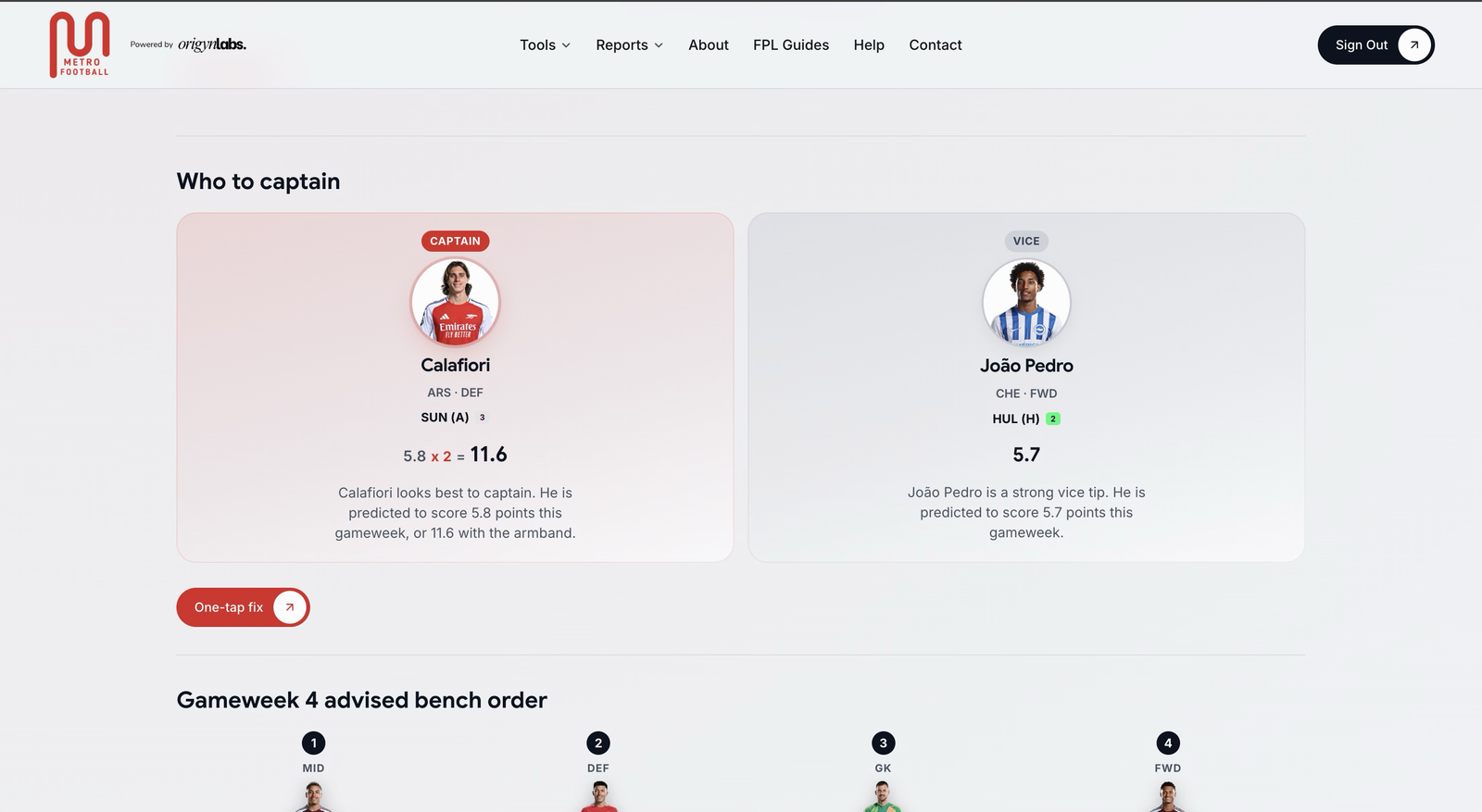
This is where Rate My Team can reduce the work. The tool reviews your squad and ranks your strongest captain options for the next Gameweek. It gives you a starting point based on your actual team rather than a general list of popular players.
You can then review the recommendation and consider your own mini league situation.
Use this tie-breaker order
If two players look close, compare them in this order:
- Expected points
Which player has the stronger projected return? - Minutes
Which player is more likely to start and play most of the match? - Fixture
Which player has the more favourable opponent and home advantage? - Attacking role
Which player takes penalties, free kicks or more shots? - Team situation
Which player’s team is creating more chances and controlling matches?
This process helps you avoid changing your captain based on one social media opinion or one recent score.
Consider your mini league position
Your captain choice can also depend on whether you are protecting a lead or trying to catch someone.
If you are near the top of your mini league, selecting a popular captain can reduce risk. You are more likely to keep pace with your rivals if the player performs.
If you are chasing, you may consider a strong but less popular option. This is where an FPL differential captain can make sense.
A differential captain is not simply a random player with low ownership. The player should still have:
- A good fixture.
- A strong attacking role.
- Reliable minutes.
- Recent involvement in chances.
- A reasonable expected score.
The best differential captain is usually a credible alternative to the most popular pick. It should give you upside without turning your Gameweek into a complete gamble.
Ownership should guide your risk level, not make the decision for you.
Step 3: Make safe FPL vice-captain picks
Your vice-captain is your safety net.
They only receive double points if your captain does not play at all. If your captain plays, even for a short period, your vice-captain does not replace them.
For that reason, your vice-captain should normally be the next-best reliable option in your team.
Good FPL vice captain picks usually have:
- A strong chance of starting.
- A good attacking role.
- A favourable fixture.
- Low rotation risk.
- A high expected score.
Do not automatically choose your most expensive player. Price does not always reflect the best option for the next Gameweek.
It can also help to choose a vice-captain who plays in a different match from your captain. This gives you more protection if there is an unexpected postponement or late team news affecting one fixture.
Before the deadline, check both players again. If your captain has picked up an injury or is unexpectedly left out, change the armband and review your vice-captain at the same time.
When should you use triple captain picks?
The Triple Captain chip doubles your captain’s points again for one Gameweek. This means your captain receives three times their normal points instead of two.
That makes the choice more important, but it does not mean you should use the chip whenever a premium player has a good fixture.
Strong FPL triple captain picks usually combine:
- A likely double Gameweek.
- Two fixtures with good attacking potential.
- A player who is very likely to start both matches.
- Penalty or set-piece responsibility.
- Strong expected points across the Gameweek.
- Limited rotation risk.
Check your wider season plan before using the chip. A future double Gameweek may offer a better opportunity.
Metro Football’s Chip Strategy Planner can help you review when to use your Triple Captain, Wildcard, Free Hit and Bench Boost. It is easier to make the decision when you consider several Gameweeks rather than only the next fixture.
How AI captain picks can help
You do not have to make every captain decision from scratch.
Metro Football’s Rate My Team tool uses your linked squad to rank captain options for the next Gameweek. Our AI tools also use team and fixture information to provide personalised recommendations.
This is useful when:
- You have two similar captain options.
- Your squad contains several premium attackers.
- You are unsure whether to follow the popular pick.
- You want a second opinion before the deadline.
- You are trying to avoid emotional decisions after a poor Gameweek.
FPL AI captain picks should support your decision, not replace your judgement. AI FPL predictions are based on available information and can be wrong. Late injuries, rotation and unexpected match events can change the outcome.
Use the recommendation as the answer first. Then check the fixture, minutes and team news before confirming your armband.
You can also use our AI Tips tool for wider squad guidance.
Common captaincy mistakes to avoid
Captaining last week’s highest scorer
A big return can influence your decision, but it does not guarantee another one.
Check the next fixture and the player’s role before giving them the armband.
Chasing a rival’s captain
You may feel pressure to copy your mini league rival. Sometimes matching their captain is sensible, especially when you are protecting a lead.
However, copying without checking the player’s fixture or minutes can lead to a weak decision.
Picking a differential for the sake of it
Low ownership is not enough. A differential captain still needs a good reason behind them.
Ignoring rotation
Midweek matches, European fixtures and congested schedules can affect minutes. Check team news before the deadline.
Changing the captain too often
Once you have applied your process, stop changing the decision unless new information appears. Constantly switching between two options can create more doubt without improving the pick.
A simple deadline checklist
Before the Gameweek deadline, ask:
- Who are my top two captain options?
- Which player has the strongest expected points?
- Are both players likely to start?
- Which fixture is more favourable?
- Who has the stronger attacking role?
- Am I choosing a differential for a clear reason?
- Is my vice-captain a safe, reliable alternative?
- Have I checked injuries and rotation news?
- Do I need to review my Triple Captain plan?
If you can answer these questions, you have made a prepared decision.
Start with Metro Football’s captain picker
You can use Rate My Team to assess your squad and see the strongest captain options for the next Gameweek.
Start free, link your FPL team and use the recommendation as part of your weekly routine. When you are ready, explore the wider Metro Football tools for transfer planning, fixture checks, chip strategy and mini league tracking.
You do not need perfect information to pick a captain. You need a clear process that helps you make the decision with less doubt.